 How-to
What Is the Best Drying Rack for Activewear Sets?
Last Updated: November 19, 2026
Quick Summary
The best drying rack for activewear is a foldable, multi-tier rack with a mesh shelf, because mesh supports leggings and bras flat while tiers add rail space without extra floor footprint. Choose an over-door or wall-leaning airer in small flats, and a three-tier foldable rack with mesh shelves if you train daily.
- Heat from a tumble dryer breaks down elastane and pulls seams and waistbands out of line.
- Reshape each piece while damp and drape leggings over a rail at the knee, never by the ankle.
- Peg a wet sports bra by the band, never by one strap, which stretches permanently.
- Two smaller foldable racks cover a full week of training better than one large rigid rack.
- Space pieces at least a hand's width apart so overlapping garments do not trap moisture.
Table of Contents
- Why a Drying Rack for Activewear Sets Beats the Tumble Dryer
- How to Air-Dry Gym Clothes Without Damaging the Fabric
- How Long Do Gym Clothes Take to Dry?
- How to Dry Leggings Without Stretching Them
- The Best Clothes Drying Rack for Small Spaces
- Which Drying Rack for Activewear Sets Suits Your Routine
- Build Your Post-Workout Drying Setup Around Your Sets
- Frequently Asked Questions
Why a Drying Rack for Activewear Sets Beats the Tumble Dryer
A drying rack for activewear sets protects the two things a tumble dryer quietly destroys: elastane recovery and fabric shape. Heat is the enemy here, not water. Tumble drying breaks down the stretch fibres that hold a sports bra and leggings in place, and the tumbling action pulls seams and waistbands out of line.
Most gymwear carries a care label telling you to line dry. That instruction is not decorative. It exists because the heat and mechanical agitation of a dryer shorten the life of stretch fabrics dramatically.
There is also a cost angle. A dryer is one of the most energy-hungry appliances in a home, and air-drying a single set costs nothing beyond the space it occupies. Elastane is exactly what heat degrades first.
If you have ever wondered why do gym clothes lose shape, the answer usually sits in the dryer. Swap it for a rack and you solve most of the problem in one move.
How to Air-Dry Gym Clothes Without Damaging the Fabric
The correct way to air-dry gym clothes is to reshape each piece while wet, hang it with support rather than tension, and keep it out of direct sun and direct heat. Airflow does the drying, not gravity.
Here is the routine we recommend:
- Rinse or wash cold first. Sweat salts left in fabric attract moisture and odour.
- Skip the spin cycle on high. A gentle spin removes enough water without crushing seams.
- Reshape while damp. Smooth waistbands, cups and hems flat with your hands.
- Hang with support. Drape leggings over a rail at the knee, not by the ankle.
- Leave gaps. Air needs to move between garments, so never overlap pieces.
- Avoid radiators and direct sun. Both fade colour and stress elastane.
Technical fabrics behave differently from cotton, and the drying method should reflect that. Our guide to technical fabric versus cotton activewear explains the difference in detail, and it is worth reading before you hang anything delicate.
Watch out: pegging a wet sports bra by one strap concentrates the weight of the whole garment on a single point, and that strap will stretch permanently. Always peg by the band or lay the bra flat.
How Long Do Gym Clothes Take to Dry?
Placement matters more than most people expect. A rack beside an open window in a heated room dries far quicker than one tucked in a cold corner. If your bathroom has no window, run an extractor fan or a dehumidifier nearby and the drying time drops noticeably.
How to Dry Leggings Without Stretching Them
Leggings keep their shape when they dry flat or draped over a wide rail, never hung vertically by the waistband. Wet fabric is heavy, and a vertical hang pulls the entire garment downward from one narrow point.
The method that works:
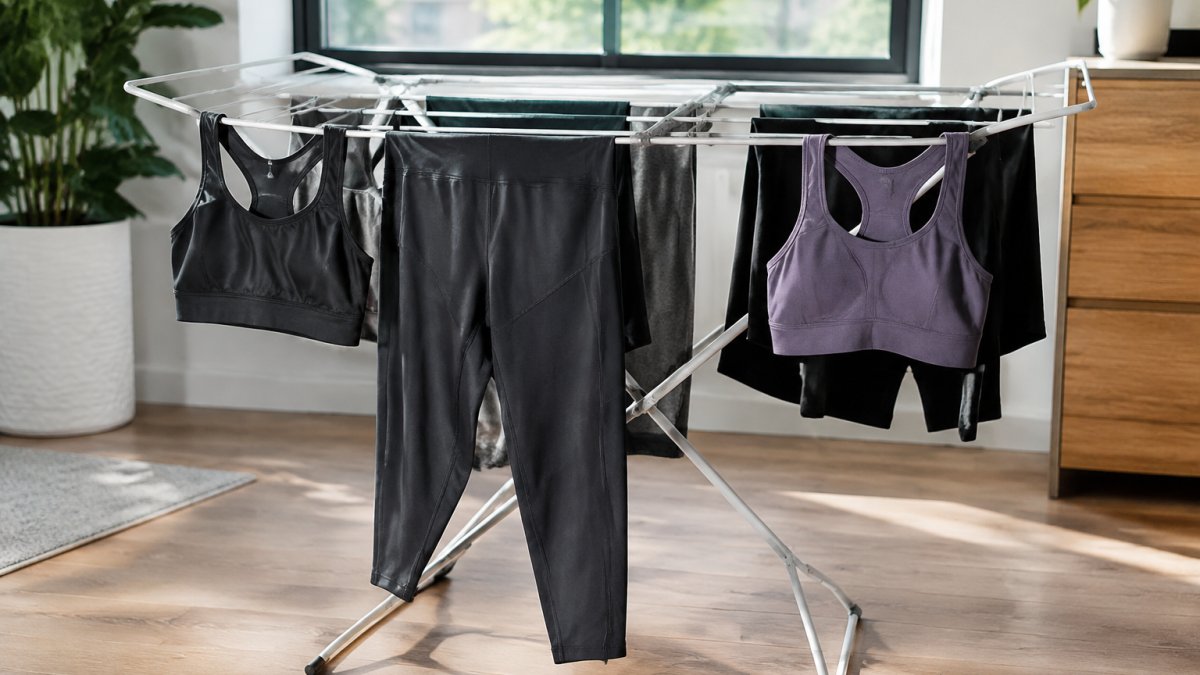
- Lay flat on a mesh drying rack if you have one. Mesh supports the whole garment evenly.
- Drape over a wide rail if you do not. Fold at the knee so weight is distributed across the rail.
- Never peg by the ankle or cuff. That stretches the hem and distorts the leg line.
- Reshape the waistband with your hands before leaving it to dry.
This matters because a stretched waistband is one of the main reasons leggings start sliding down mid-squat. If that is already happening to you, our guide on how to stop leggings sliding down covers the causes and the fixes.
The Best Clothes Drying Rack for Small Spaces
The best clothes drying rack for small spaces is a foldable, wall-leaning or over-door airer with at least two tiers, because it uses vertical space without permanently occupying floor area. But for activewear specifically, the right choice depends on where you actually wash and dry your sets, usually a bathroom, a bedroom corner or a shared utility space, and how quickly you need them back in rotation.
What to prioritise for activewear in a small home:
- Fold-away design: folds flat for storage behind a door or under a bed.
- Two or more tiers: more drying rails without more floor footprint. Two tiers comfortably hold one full set, top and leggings, with gaps between them.
- Steel or aluminium frame: lighter to move, stable when loaded. Aluminium resists rust in steamy bathrooms better than untreated steel.
- Mesh shelves: essential for bras and delicate pieces that need flat drying. A mesh panel also stops small items slipping between rails.
- Weight capacity: check it, because a full rack of damp leggings is heavier than it looks.
- Wing or arm extensions: side wings add hanging space for tops without widening the floor footprint, which matters in narrow bathrooms.
Where to put it matters as much as what you buy. A rack placed in a bathroom with an extractor fan running will dry a set faster than one in a cold bedroom corner, because moving air removes moisture from the fabric surface. If your bathroom has no window, run the extractor for the first hour after hanging and leave the door ajar afterwards.
Watch out: over-door airers concentrate weight on the top of the door, and a full rack of damp leggings can pull a lightweight hollow-core door out of alignment over time. Check the door's construction before loading it heavily, or choose a wall-leaning design instead.
A common pattern in small flats is to buy a large, rigid rack for the extra capacity, then resent the floor space it takes up and stop using it. A better approach is two smaller foldable racks: one over-door or wall-leaning for daily sets, and one compact tiered rack with a mesh shelf for bras and delicates.
If you dry in a shared laundry or utility room, prioritise a rack that folds flat enough to store in a cupboard and is light enough to carry one-handed. If you dry in a bathroom, prioritise rust-resistant frame material and a mesh shelf.
Which Drying Rack for Activewear Sets Suits Your Routine
Match the rack to your routine, not to the biggest model on the shelf. Someone training five times a week needs more drying capacity than someone training twice.
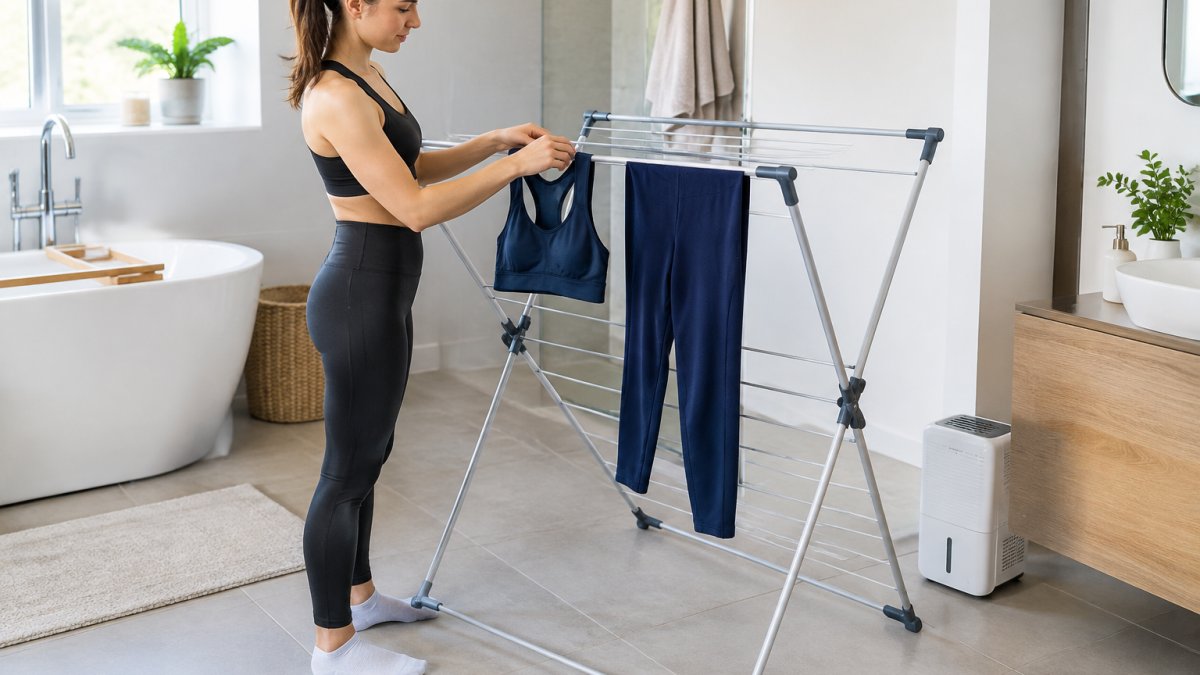
Use this quick decision guide:
| Your situation | Best rack type | Why it fits |
|---|---|---|
| Small flat, one or two sets a week | Over-door or wall-leaning airer | Zero floor footprint, folds flat |
| Daily training, shared laundry | Three-tier foldable rack with mesh shelves | High capacity, flat-dry option |
| Flat-drying bras and delicates | Tiered rack with mesh panels | Even support, no strap stretch |
| Bathroom drying, no window | Compact rack plus extractor or dehumidifier | Airflow compensates for humidity |
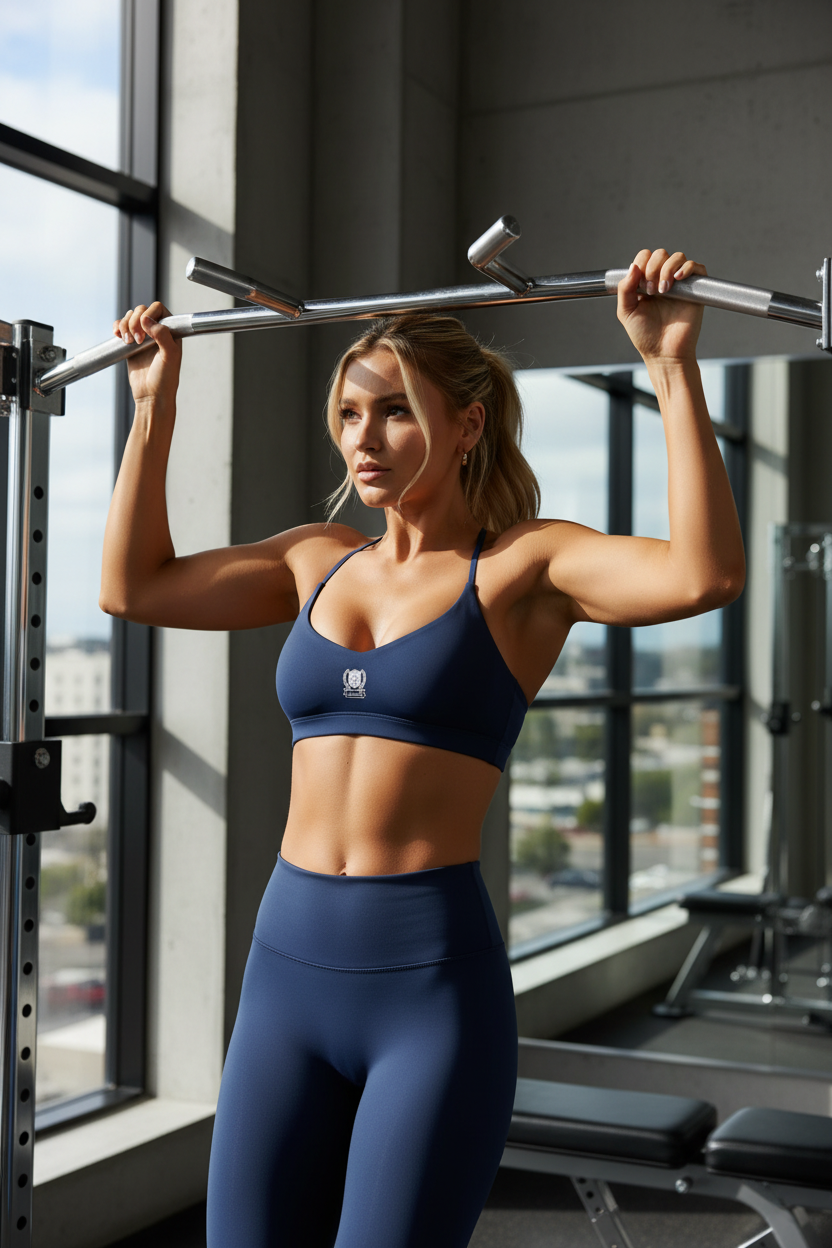
Whatever you choose, pair it with a set worth protecting. The GrantB Sculpt Set is built from that same quick-drying nylon and elastane blend, so it air-dries faster than cotton and holds its shape across repeated washes.
Build Your Post-Workout Drying Setup Around Your Sets
A drying setup works best when it is built around the garments you actually train in. That means knowing which pieces need flat drying, which can hang, and how much rail space a full week of sets requires, and, just as importantly, how to stop sweaty kit turning musty before it dries.
A simple routine:
- Rinse immediately after training and hang the set before you shower. A quick rinse in cold water lifts sweat salts before they set into the fibres.
- Rotate two racks' worth of space if you train daily, so nothing sits damp overnight. Damp fabric left in still air is where odour starts.
- Keep one mesh shelf free for bras and any padded pieces.
- Check the room's airflow each season, since winter drying is slower and a cold room holds moisture longer.
- Space pieces at least a hand's width apart. Overlapping garments trap moisture between layers and slow drying on both.
Odour and mildew come from damp fabric left in still air, not from the fabric itself. The bacteria that cause gym-kit smell thrive in warm, moist conditions, so the goal is to get the fabric dry quickly rather than to mask the smell with detergent. A few practical steps make a real difference:
- Wash at the lowest temperature on the care label and use a detergent designed for technical fabrics rather than a heavy biological powder, which can leave residue that holds odour.
- Never leave a wet set in the washing machine. Transfer it to the rack within an hour of the cycle finishing.
- Dry the set inside out so the side that touched your skin dries first and any lingering bacteria are exposed to air.
- Air the rack space daily. Opening a window for ten minutes in the morning does more than leaving it shut all day.
Speeding up drying safely is where most people go wrong. A fan is the safest accelerator: point an oscillating fan at the rack from about a metre away so air moves across the whole setup rather than blasting one garment.
Watch out: never drape activewear directly over a radiator, a heated towel rail or the back of a fan heater. Contact heat stresses elastane, so indirect warmth in a room with moving air is the safer option.
If you train daily, build a rotation rather than a single drying spot. Our women's collection gives you the full range of sets to build that rotation around, from shorts sets for summer training to layered performance sets for colder months.
Getting your drying routine right is the cheapest way to extend the life of every set you own. GrantB Sportswear designs gymwear that holds its shape through constant washing, with a 78% nylon, 22% elastane blend that dries quickly and recovers after every session.
Frequently Asked Questions
What is the best way to dry activewear?
Air-dry it flat or draped over a rail, out of direct sun and away from direct heat. Turn garments inside out so the moisture-wicking face dries first, and leave space between pieces so air can move. A drying rack for activewear sets works better than a radiator because the fabric never sits against a hot surface. The 78% nylon, 22% elastane blend in GrantB sets gives four-way stretch, and keeping it off a tumble dryer helps protect that elastane.
Can you put gym leggings in a tumble dryer?
Avoid it where you can. Heat and tumbling break down elastane over time, which is what causes leggings to lose shape, go baggy at the knee and stop holding you in place. If you must use a dryer, choose the lowest heat setting and take the item out while still slightly damp. Air-drying on a rack takes longer but keeps the fabric's stretch and moisture-wicking finish intact for far more washes.
How do you stop workout clothes from smelling after washing?
Wash sweaty kit soon after training, use a wash cycle that rinses thoroughly, and dry it completely before it goes back in a drawer. Odour lingers when bacteria stay trapped in damp fabric, so a rack with good airflow matters as much as the wash. Leave gaps between garments, dry sports bras upside down so water does not pool in the cups, and never put away anything that still feels cool or damp to the touch.
Should you hang or lay activewear flat to dry?
Most gym kit is fine hung over a rail or on a hanger, but heavy or wet pieces do better laid flat. Wet leggings hung by the waistband can stretch under their own weight, so drape them over a rail at the knee instead. Sports bras keep their shape better laid flat or hung upside down. A rack with a mesh shelf handles both, and you can swap between hanging and flat drying as each garment needs.