 blog
Crafted for the Modern Athlete vs Designed for Peak Performance
Last Updated: October 23, 2026
Quick Summary
For stay-put leggings, "designed for peak performance" points to firmer hold, denser fabric and stronger waistband support, while "crafted for the modern athlete" prioritises softer fabric and all-day versatility. Neither phrase is a specification, so judge hold by waistband depth, elastic recovery and seam construction instead of the slogan.
- High-waisted bands hold better than mid-rise for most training because they sit above the widest part of the hips.
- A lined or double-layer waistband resists rolling far better than a single layer of elastic.
- Choose the highest compression you can wear comfortably for your longest session, not the highest number on the label.
- Wash at 30°C or lower and air dry to protect elastane and preserve elastic recovery.
- Test the band across squats, lunges and twenty burpees, counting any readjustments needed.
Table of Contents
- What "Crafted for the Modern Athlete" and "Designed for Peak Performance" Actually Promise
- Why Stay-Put Leggings Need Different Construction From Everyday Leggings
- How Waistband Construction Decides Whether Leggings Stay Up During Workouts
- High-Waisted vs Mid-Rise Gym Leggings: Which Holds Better
- High-Compression Leggings: The Trade-Off Between Hold, Comfort and All-Day Wear
- What Makes the Best Leggings for HIIT Workouts
- Squat-Proof Coverage, Opacity and Fabric Recovery
- Testing Stay-Put Claims Across Body Shapes and Activities
- Care, Wear and Long-Term Performance
- Frequently Asked Questions
What "Crafted for the Modern Athlete" and "Designed for Peak Performance" Actually Promise
Two phrases dominate activewear marketing in 2026, and they are not interchangeable. "Crafted for the modern athlete" sells a lifestyle: training that moves between the gym floor, the commute and the office. "Designed for peak performance" sells an outcome: a garment built to hold its shape under maximum load. At GrantB Sportswear, we read both claims through one lens, because for stay-put leggings the wording on the label tells you almost nothing about whether the waistband will survive a set of heavy squats.
Here is the uncomfortable truth most buying guides skip: both phrases are positioning statements, not specifications. Neither one obliges a brand to disclose elastane content, waistband depth or seam construction. The only way to judge a pair of stay-put leggings is to read the construction details underneath the slogan.
Where the two phrases overlap
Both promises imply movement, durability and a fit that does not need constant readjustment. A garment marketed either way should offer four-way stretch, elastic recovery and enough coverage to avoid becoming see-through when stretched. Where the language converges, the practical expectations are the same.
Where they diverge
"Crafted for the modern athlete" leans on versatility. It suggests a legging that works for a spin class at 6am and a desk by 9am, which usually means softer fabric and less aggressive compression. "Designed for peak performance" leans on intensity: firmer hold, denser fabric, stronger waistband support. The first prioritises all-day comfort; the second prioritises stability during high-impact movement. Understanding this split is the difference between buying leggings that stay up during workouts and buying leggings that merely look the part.
Why Stay-Put Leggings Need Different Construction From Everyday Leggings
Everyday leggings are engineered for appearance. Performance leggings are engineered for load.
The distinction sits in three places: fabric density, elastic recovery and waistband structure. A dense knit resists thinning when you drop into a squat, which is what keeps opacity intact. High elastane content gives the fabric the memory to return to its original shape rather than bagging at the knee after twenty minutes of training. And a deep, structured waistband distributes pressure across the hips instead of concentrating it at a narrow elastic strip that rolls the moment you hinge forward.
A common mistake is assuming a tight fit equals a secure fit. It does not. A legging can feel compressive at the mirror and still slide down mid-set because the waistband has no grip and the fabric has no recovery. Slippage often comes from poor construction, not from the wearer choosing the wrong size.
How Waistband Construction Decides Whether Leggings Stay Up During Workouts
Waistband construction is the single biggest factor in whether leggings stay up during workouts, and it is the part of a legging most buying guides describe in adjectives rather than mechanisms. A wide, high-rise band with a bonded or double-layer finish grips the hips and spreads tension; a narrow elastic strip concentrates force and rolls under movement. The difference is not cosmetic, it is structural, and it can be inspected before you buy.
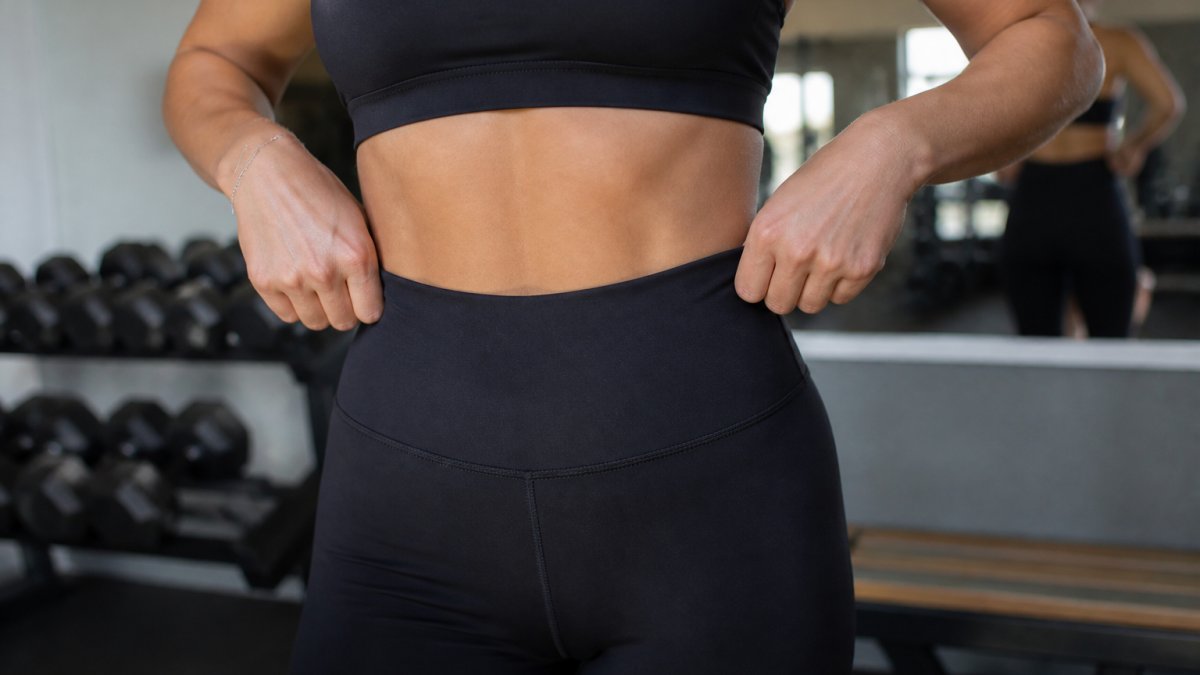
The five construction variables that decide hold
1. Band depth. Deeper bands resist rolling because there is more surface area in contact with the body, which spreads the load across the hips and lower core rather than concentrating it at one narrow line. As a rule of thumb, a deeper band gives noticeably more roll resistance than a narrow strip, though the exact figure matters less than the ratio of band depth to the tension the fabric carries.
2. Grip and interface. Grip comes from two things: friction between the band's inner surface and the skin, and the band's ability to resist sliding upward or downward under load. A silicone or textured inner strip adds friction, but it only helps if the band is deep enough to stay flat; a grippy narrow band still rolls. Bonded edges sit flatter against the body than stitched edges and reduce the ridge that catches during hinging.
3. Seam placement. The top edge seam should sit flat rather than dig in. A seam that puckers or a stitched channel that bunches creates a pressure line that migrates under movement. Flatlock or bonded finishes distribute tension more evenly than a standard overlock seam.
4. Elastic recovery. A band holds only as well as the elastane in it recovers. High elastane content with good recovery returns the band to its original circumference after stretching; a band that has lost recovery stays stretched and slides. This is why a pair can feel secure on day one and loose after a month of hot washing.
5. Lining and layering. A lined or double-layer band holds its shape far better than a single layer of elastic, because the two layers resist twisting and folding independently. Single-layer bands are lighter and cooler but are the first to roll during burpees and deadlifts.
How to inspect a waistband before you buy
A repeatable check you can run in the changing room or on delivery:
- Fold the band in half along its depth, a lined band springs back flat, a single layer creases and stays creased
- Stretch the band widthways and release, good recovery snaps back without a wavy edge
- Run a thumb along the top seam, a flat, bonded edge sits smooth; a puckered seam will dig in under load
- Check the inner face for a grip strip or textured finish rather than bare smooth fabric
- Confirm the band depth in the product listing; if it is not stated, treat the hold as cosmetic
If you already own leggings that slide, check the band before you check the price, and judge it by depth, recovery and interface rather than by how tight it feels in the mirror. For practical fixes and construction insights, see how to stop leggings sliding down.
High-Waisted vs Mid-Rise Gym Leggings: Which Holds Better
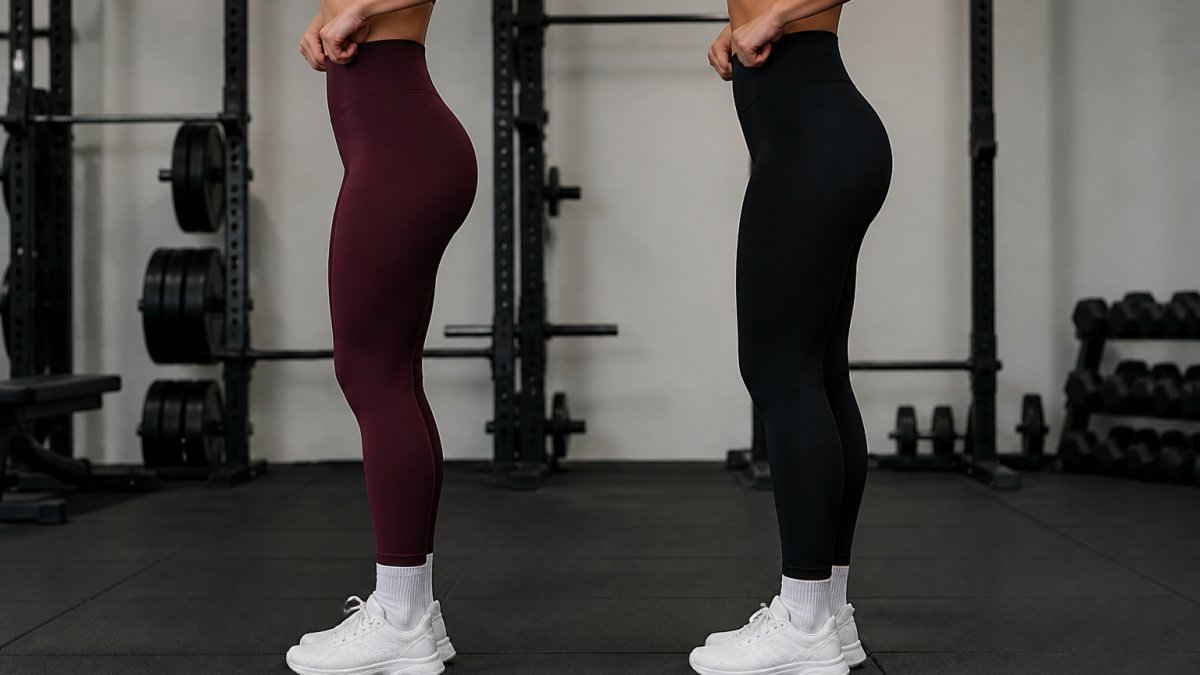
For most training, high-waisted gym leggings hold better than mid-rise. The extra rise gives the waistband more real estate across the hips and lower core, which means more grip and less roll during hinging movements. But the honest answer is that rise is only half the story, the band's construction and the wearer's torso length decide the rest, and that is where most comparisons stop.
Mid-rise has its place. If you prefer less coverage around the midsection or train mostly in yoga and pilates, a mid-rise band can feel less restrictive. The trade-off is that mid-rise sits closer to the natural waist pivot, so it is more prone to slipping during deadlifts and burpees.
| Feature | High-Waisted | Mid-Rise |
|---|---|---|
| Waistband grip | Stronger, more surface contact | Moderate |
| Roll resistance | High during hinging | Lower |
| Core support | Noticeable | Minimal |
| Best for | Lifting, HIIT, running | Yoga, pilates, casual wear |
| All-day comfort | Good with breathable fabric | Lighter feel |
Why rise changes slippage, the mechanism
A waistband stays put when the tension it carries is balanced against the friction at its interface and the recovery of the fabric. A high rise moves the band's anchor point above the widest part of the hips and closer to the natural waist, where the torso narrows. That geometry gives the band a ledge to sit on rather than a slope to slide down. A mid-rise band sits nearer the hip pivot, where every hinge, squat and jump rotates the fabric against the skin and encourages migration.
Torso length matters as much as rise. On a long torso, a high-rise band may still sit below the natural waist and behave like a mid-rise; on a short torso, a high rise can reach the ribcage and dig in when you brace. The label's rise measurement is a starting point, not a guarantee.
A repeatable stay-put test across body shapes and activities
Most stay-put claims are asserted, not tested. A simple protocol you can run at home, and the one we use to judge a band, compares roll, migration and readjustments across three activities:
- Squats (10 reps): check whether the top edge has rolled or folded after the set
- Lunges (10 per leg): check whether the band has migrated downward at the front
- Burpees or tuck jumps (20 reps): count the number of tugs needed to keep the band in place
- Steady run (10 minutes): check for upward creep at the back and side seams
Score each on a simple three-point scale, no movement, minor movement, required readjustment, and repeat on a curvier and a narrower frame if you can. A band that survives twenty burpees without a single readjustment will handle a walk to the office; one that needs a tug after ten squats will not survive a HIIT class regardless of its rise.
Before committing to a rise, it helps to understand why high waisted gym leggings work harder during high-impact training. The core support is not marketing: a wider band genuinely stabilises the midsection when you brace, provided the band is deep, lined and recovers, rather than merely high.
High-Compression Leggings: The Trade-Off Between Hold, Comfort and All-Day Wear
High-compression leggings deliver more muscle stabilisation and a firmer hold, but they ask something in return: less forgiveness during long wear. Compression reduces muscle vibration and gives a second-skin feel, which many lifters prefer for heavy compound movements.
The problem arrives at hour six. A garment built for peak performance in the gym can feel restrictive at a desk, particularly around the waistband and upper thigh. That is why the "modern athlete" promise and the "peak performance" promise pull in different directions: one optimises for the transition to daily wear, the other for the session itself.
The practical rule: choose the highest compression you can wear comfortably for the length of your longest session, not the highest number on the label. To compare which leggings actually deliver the highest compression, see which leggings offer the highest compression.
What Makes the Best Leggings for HIIT Workouts
The best leggings for HIIT workouts combine a secure waistband, dense squat-proof fabric and quick-drying moisture management. HIIT punishes weak construction because it mixes explosive jumps, floor work and rapid direction changes in a single session.
Look for four-way stretch that snaps back rather than stretching out, flatlock seams that will not chafe during burpees, and a high-rise band that stays put through tuck jumps. Breathability matters as much as hold: a fabric that traps heat will feel clammy by the third round, and damp fabric is more likely to shift.
GrantB Sculpt Leggings are built around this brief. The 78% nylon, 22% elastane composition gives a second-skin finish with the elastic recovery HIIT demands, while the supportive high waistband is designed to stay in place through cardio, strength training and yoga. Breathable, moisture-wicking fabric keeps the quick-drying feel intact across a full session, and the full-length cut provides coverage through the leg.
Squat-Proof Coverage, Opacity and Fabric Recovery
Squat-proof is a coverage claim, not a fit claim. A legging is squat-proof when the fabric stays opaque under maximum stretch, which comes down to knit density rather than thickness.
Opacity fails when a fabric thins as it stretches. Dense knits hold their colour and structure under tension; loose knits go sheer at the seat and inner thigh. Fabric recovery is the second half of the equation: a legging that has lost its elasticity will stretch further than intended, and that extra stretch is exactly when coverage breaks down.
This is where cheap construction reveals itself. A pair can pass the mirror test on day one and fail it after a month of washing, because the elastane has degraded and the knit no longer returns to shape.
For specific recommendations that back up the coverage claims, the selection criteria mirror the ones above: density, recovery, and a waistband that does not rely on a single elastic strip.
Testing Stay-Put Claims Across Body Shapes and Activities
Stay-put claims deserve scrutiny because they are rarely tested across body shapes. A waistband that grips a narrow hip can roll on a curvier frame, and a rise that sits perfectly on a long torso can dig in on a shorter one.
We assess hold across three variables: body shape, activity type and session length. A burpee-heavy HIIT class stresses the band differently from a steady run or a heavy deadlift session. Testing across all three reveals whether a legging genuinely stays put or simply performs in one scenario.
A practical test you can run at home: wear the pair for a ten-minute session of squats, lunges and jumps, then check whether the waistband has rolled, migrated or required a single tug. That short test tells you more than any product description.
Care, Wear and Long-Term Performance
Long-term performance depends on how you wash as much as how you buy. Elastane degrades with heat, so washing cool and skipping the tumble dryer preserves elastic recovery far longer than any fabric technology.
- Wash at 30°C or lower to protect elastane
- Skip fabric softener, which coats fibres and reduces wicking
- Air dry rather than tumble dry
- Wash inside out to protect seam and surface finish
- Avoid washing with velcro or zips that snag the knit
A common mistake is treating performance leggings like everyday cotton. Heat and softener both shorten the useful life of a technical knit, and once recovery goes, the stay-put fit goes with it.
The real challenge is that most leggings look identical on a hanger, so the difference between a band that holds and one that rolls only shows up mid-set. GrantB Sportswear builds for that moment: the Sculpt Leggings pair a supportive high waistband with squat-proof, non-see-through fabric and four-way stretch that recovers rather than sags. At £34.99, with free UK delivery and £10 off orders over £100, you get construction designed for peak performance and a silhouette that works beyond the gym. View the GrantB Sculpt Leggings and train without a single readjustment.

Frequently Asked Questions
What makes leggings stay up during a workout?
Three things do most of the work: a wide, structured waistband with enough vertical coverage to grip rather than pinch, a fabric with strong elastic recovery so it returns to shape instead of stretching out, and correct sizing. A 78% nylon, 22% elastane blend, like the one used in the GrantB Sculpt Leggings (£34.99), gives four-way stretch with enough density to hold without digging in. If the waistband rolls or the fabric bags out after twenty minutes, the leggings will slide regardless of how tight they feel when you first put them on.
Are high-waisted leggings better than mid-rise for staying in place?
For high-impact training, usually yes. A high-rise waistband sits above the hip bone and covers more of the lower torso, which gives it more surface to grip and reduces the chance of it rolling down during squats, hinges or sprint intervals. Mid-rise works well for yoga, walking and everyday wear, where a lower cut feels less restrictive. The deciding factor is whether the waistband has structure. A flimsy high waistband will still slip; a well-constructed mid-rise can hold through moderate training.
How should high-compression leggings fit?
They should feel firm and supportive without restricting your range of motion or leaving deep marks when you take them off. You should be able to squat, lunge and breathe normally, and the waistband should sit flat with no gaping at the back. If you are between sizes, size up rather than down: over-compression strains the seams and speeds up elastic fatigue, which is what causes leggings to loosen over time. Compression should feel like support, not like being squeezed.
Do compression leggings improve workout performance?
The evidence is mixed and depends on the activity. Compression garments are used to support muscle stabilisation and reduce vibration during repeated impact, and many lifters and runners report feeling more secure and less fatigued. What is clearer is the practical benefit: a supportive hold keeps the waistband in place, so you are not readjusting mid-set. Treat compression as a comfort and confidence feature rather than a guaranteed performance boost, and prioritise fit and fabric recovery over how tight a pair feels.