 How-to
Choosing the Right Performance Jacket for Work: A Step-by-Step Guide
Last Updated: November 5, 2026
Quick Summary
Choosing the right performance jacket for work starts with the job itself: indoor roles need a light, breathable layer, while outdoor roles need a wind- and water-resistant shell. Match the jacket to your typical shift and climate, then check fit over your layers before you buy.
- Indoor roles need a lightweight, breathable layer; outdoor roles need a wind-resistant, water-resistant shell.
- A waterproof jacket suits long periods of outdoor rain, while a water-resistant one suits occasional showers.
- Check fit with overhead, forward and squat reach tests while wearing the layers you will actually use.
- Compare waterproofing in millimetres of hydrostatic head and breathability in g/m²/24h rather than marketing terms.
- Divide the price by expected shifts to compare cost per wear, since durability changes the real cost more than the price.
Table of Contents
- Start by Defining the Job and Work Environment
- Step 2: Match Climate, Season and Weather Conditions
- Step 3: Choose a Waterproof Work Jacket or a Water-Resistant Alternative
- Step 4: Decide Between a Softshell Work Jacket and a Hard Shell
- Step 5: Assess Breathability, Ventilation and Heat Management
- Step 6: Check Fit, Sizing and Freedom of Movement
- Step 7: Evaluate Fabric, Insulation, Pockets and Practical Features
- Step 8: Look for Standards, Test Data and Total Cost of Ownership
- Booking Your Next Work Jacket: Caring for It and Choosing Your Pick
- Frequently Asked Questions
Start by Defining the Job and Work Environment
Choosing the right performance jacket for work starts with one question: what does your job actually ask of your body? A site surveyor, a warehouse picker and a delivery driver all need different things from the same zip-up. This guide helps UK buyers match the jacket to the job before they look at fabric or price.
Start with where you spend most of your shift. Indoor work, outdoor work and mixed roles each put different demands on a jacket.
Matching the jacket to indoor, outdoor and mixed roles
Indoor roles need comfort and freedom of movement more than weather protection. Outdoor roles need the reverse. Mixed roles, where you move between a warm office and a cold yard, need a jacket that layers well.
- Indoor roles: a lightweight, breathable layer that does not overheat you
- Outdoor roles: a wind-resistant, water-resistant outer shell
- Mixed roles: a softshell or a light insulated layer you can add or remove
Think about how much you bend, lift and reach. A jacket that fits well in a seated role may restrict you on a scaffold or a loading dock. Write down your main tasks, then rank the jacket features against them.
Watch out: buying for the coldest day you expect can leave you overheated for most of the year. Plan for your typical shift, then add a layer for the worst days.
Step 2: Match Climate, Season and Weather Conditions
Your local climate decides how much protection you need. A jacket that works in a dry UK autumn may fail in a wet January. Look at the months you will wear it most, not just the coldest peak.
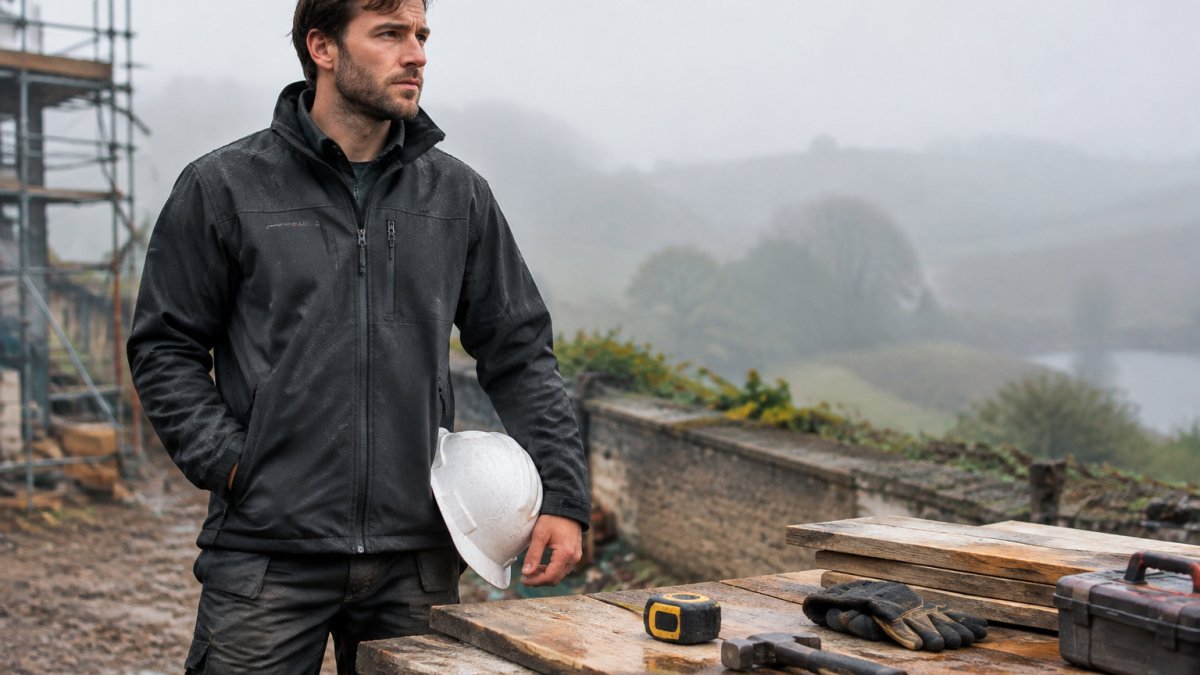
Here is a simple way to match the jacket to conditions:
- Mild, dry conditions: a breathable softshell or light layer
- Cold, dry conditions: an insulated jacket with a wind-resistant shell
- Wet and windy conditions: a waterproof outer shell with taped seams
- Changeable conditions: a jacket you can layer with a base and a mid-layer
Most UK workers face changeable weather. A jacket with a removable or adaptable layer gives you more control over the day. It also saves you from buying two separate jackets.
Step 3: Choose a Waterproof Work Jacket or a Water-Resistant Alternative
The difference between waterproof and water-resistant matters. A waterproof jacket stops rain getting through in heavy weather. A water-resistant jacket sheds light showers but can soak through in prolonged rain.
Choose a waterproof jacket if you work outside in rain for long periods. Choose a water-resistant jacket if you face occasional showers and want more breathability.
Check these points before you buy:
- Taped or sealed seams, which stop water entering through stitching
- A storm flap over the zip
- Adjustable cuffs and hem to block draughts and rain
Watch out: a waterproof shell that is not breathable can make you sweat heavily during hard work. Many workers find that a water-resistant jacket is more comfortable for active tasks.
The table below sets out how the two options differ, so you can match the jacket to how wet your work gets.
| Option | Best for | Key difference |
|---|---|---|
| Waterproof jacket | Long periods of outdoor rain | Stops rain getting through in heavy weather |
| Water-resistant jacket | Occasional showers | Sheds light rain but can soak through over time |
| Waterproof jacket | Taped seams and storm flap | Seams sealed against water entering through stitching |
| Water-resistant jacket | Active tasks | Usually more breathable and comfortable |
Step 4: Decide Between a Softshell Work Jacket and a Hard Shell
A softshell work jacket is stretchy, breathable and wind-resistant, but it is usually less waterproof than a hard shell. A hard shell is a rigid, fully waterproof outer layer built for heavy rain and storms.
Use a softshell when you move a lot and face mild weather. Use a hard shell when you stand still outdoors in wet conditions or need full rain protection.
Many workers keep both. A softshell covers most days, and a hard shell covers the worst weather.
Step 5: Assess Breathability, Ventilation and Heat Management
Breathability decides how comfortable you feel after an hour of work. A jacket that traps sweat can leave you cold once you stop moving, which is a common problem with heavy shells.
Look for these features:
- Breathable fabric: lets moisture escape from your skin
- Pit zips or mesh-lined vents: release heat during hard work
- Moisture-wicking base layers: pull sweat away from your body under the jacket
Heat management matters most in roles with changing workload. You may climb a ladder, then stand still in a cold yard. Vents and layers let you adjust without stopping the job.
Watch out: a jacket with no vents and a heavy lining can overheat you within minutes of physical work.
Step 6: Check Fit, Sizing and Freedom of Movement
A work jacket must fit over your base layers and still let you move freely through the tasks your job actually involves. A jacket that is too tight restricts your arms and shoulders; one that is too loose catches on equipment and lets cold air in.
The task-based fit test
Before you commit, put the jacket on over the layers you will actually wear and run through these checks:
- Overhead reach: raise both arms overhead. The hem should not ride up past your waistband, and the cuffs should not pull back past your wrists.
- Forward reach: reach forward as if picking up a box. The sleeves should stay in place and the back should not pull tight across the shoulders.
- Squat and kneel: squat down and check the jacket does not bunch uncomfortably at the waist or ride up at the back.
- Twist: turn your torso left and right. The jacket should follow without gaping at the neck or pulling at the zip.
- Layer check: wear your usual base layer and mid-layer. If the jacket is tight over both, size up; if it is loose over a single layer, consider whether you will always wear it over a mid-layer.
Sizing across brands and body shapes
Sizing is not standardised across brands. A size medium from one maker may fit like a large from another, and workwear cuts often assume a straight-up-and-down shape. Compare your chest, waist and sleeve measurements to the brand's size chart rather than relying on your usual size.
If you are between sizes, size for the layers you will wear most. A jacket that is slightly roomy over a base layer can be cinched at the hem and cuffs; one that is too tight cannot be fixed.
Fit over layers and across the seasons
A jacket worn over a base layer in autumn may need to fit over a mid-layer and a base layer in winter. If you plan to layer, size for the thickest combination you will use, then use the hem and cuff adjusters to cinch the jacket when you wear fewer layers. A jacket that fits well over a single layer but cannot accommodate a mid-layer will be unusable in cold weather.
Watch out: buying a jacket that fits perfectly over a t-shirt but not over your work fleece is a common and costly mistake. Take your mid-layer to the fitting if you can, or measure the chest and sleeve length of the layers you wear most and add a few centimetres for the jacket.
Sizing varies between brands, so a size medium from one maker may fit like a large from another. Read the size guide carefully before you order, and check the returns policy in case the fit is wrong.
Step 7: Evaluate Fabric, Insulation, Pockets and Practical Features
Fabric affects durability, stretch and comfort. Nylon blends are common in performance jackets because they resist abrasion and dry quickly. GrantB Sportswear's own fabrics use a 78% nylon and 22% elastane blend, which gives four-way stretch and a close, comfortable fit. You can read more on the Our Fabrics page.
For a jacket you wear daily, the fit and stretch of a fabric like this may suit active, mixed roles. For outdoor work in heavy weather, you may need a tougher outer shell with extra abrasion resistance.
Practical features save time during a shift:
- Chest pocket: keeps a phone or pen within reach
- Zipped pockets: keep valuables secure while you move
- Adjustable hem and cuffs: lock out draughts and rain
- Full-length zip: makes the jacket easy to put on and take off
Insulation depends on your climate. A light insulated layer adds warmth without bulk. Heavier insulation suits static, cold roles but can overheat active workers.
For a lighter layer that suits warm-ups and active shifts, see the GrantB Performance Jacket. For a smaller, lightweight option that layers under an outer shell, the GrantB Studio Vest is worth a look.


Step 8: Look for Standards, Test Data and Total Cost of Ownership
A jacket's price is only part of its cost, and a claim on a swing tag is only part of its performance story. This section covers how to verify what a jacket actually delivers, and how to work out what it will cost you over its life.
Standards and certification: what to check and who enforces it
Common standards you will see on UK workwear labels include:
- EN ISO 20471 for high-visibility clothing, graded by class (Class 1, 2 or 3) depending on the amount of fluorescent and retroreflective material. Class 3 offers the highest visibility (High visibility clothing).
- EN ISO 11612 for clothing protecting against heat and flame.
- EN 1149 for anti-static properties, often required in environments with flammable atmospheres.
- EN 343 for waterproofness and breathability, rated on a scale from 1 to 3 for each property.
- EN 14058 for protective clothing against cool environments, covering thermal insulation.
A certified garment carries a label or declaration of conformity (DoC) naming the standard, the performance level and the notified body that tested it. Ask the supplier for the DoC if it is not supplied. Do not assume a jacket is certified because it looks the part; the label is the evidence.
Test data: translating claims into comparable numbers
Performance terms are only useful if you can compare them. Ask for measurable specifications rather than marketing language:
- Waterproofing: look for a hydrostatic head rating in millimetres (mm). A rating of 5,000 mm resists light rain; 10,000 mm handles steady rain; 20,000 mm and above suits prolonged exposure. EN 343 uses a 1-3 scale, but the raw mm figure is more directly comparable.
- Breathability: measured in grams of moisture vapour per square metre per 24 hours (g/m²/24h) or as a RET value (the lower the RET, the more breathable). Figures above 10,000 g/m²/24h suit active work; below 5,000 g/m²/24h may feel clammy during hard effort.
- Insulation: expressed in clo or tog; for workwear, the EN 14058 rating and the garment's thermal resistance give a more useful comparison than 'warm' or 'lightweight'.
- Wind resistance: measured in air permeability (mm/s or cfm); lower values mean better wind blocking.
If a seller cannot supply these figures, treat the claim as unverified. A common pattern is that budget jackets quote waterproofing but omit breathability, which matters more for active roles.
Total cost of ownership: care, repair and replacement
The purchase price is the starting point, not the whole cost. Work out cost per wear by dividing the price by the number of shifts you expect to wear it. A £120 jacket worn 150 times costs £0.80 per wear; a £60 jacket that fails after 40 shifts costs £1.50 per wear. Durability changes the maths more than the ticket price.
Factor in these running costs:
- Laundering: domestic washing is cheaper than specialist cleaning. Check the care label; frequent high-temperature washing can degrade water-repellent finishes. Reproofing sprays and washes cost around £10-£20 and extend the life of a waterproof shell.
- Repair: replacing a zip or patching a seam is usually far cheaper than a new jacket. Reinforced stress points at shoulders, elbows and cuffs reduce repair frequency.
- Replacement cycle: a jacket used daily in harsh conditions may need replacing every 18-24 months; a lighter softshell for indoor or mixed roles may last several years.
- Warranty: check what the warranty covers and for how long. A warranty that covers seams and zips for two years is worth more than one that excludes wear and tear.
Keep a simple log of when you bought the jacket and when it first needed repair. Over two or three replacement cycles, the pattern becomes clear, and you can compare brands on real cost rather than first price.
For a buying guide on whether premium activewear is worth the price, see the Premium Gymwear Buying Guide.
Booking Your Next Work Jacket: Caring for It and Choosing Your Pick
Before you order, check the delivery times and return terms, since a jacket that does not fit should be easy to send back. GrantB Sportswear offers free UK shipping on orders, and you can check delivery and returns on the Shipping & Returns page. Orders over £100 also get £10 off.
Pick the jacket that matches your job, your climate and your fit needs. A performance jacket that suits your role will serve you better than the most expensive option on the shelf.
Care for it properly to keep it working. Wash it on a gentle cycle, avoid fabric softener, which can reduce water resistance, and air dry it away from direct heat. Check the seams and zips after a few months of use and repair small damage early.
Start with the job, not the jacket. Once you know what your work demands, the right choice is much easier to spot.
Frequently Asked Questions
What should you look for in a work jacket?
Start with the job itself. Outdoor roles in the UK need weather protection, such as a waterproof or water-resistant shell with taped seams, while indoor or light-duty roles may only need warmth and breathability. Check for adjustable cuffs and hem, practical pockets, a secure zip, and enough mobility to reach, bend and lift without the jacket riding up. Breathability matters as much as protection, because a jacket that traps sweat will leave you chilled once you stop moving. Test the jacket in the conditions you actually work in before committing to a full working week.
How should a work jacket fit?
A work jacket should allow a layer underneath, such as a fleece or thermal top, without restricting your arms. Raise your arms overhead and reach forward while wearing it: the back should not pull tight and the sleeves should not ride up sharply. Articulated sleeves and a slightly longer back help during bending and kneeling. Measure your chest and compare the brand's size chart in centimetres rather than relying on your usual size, as fit varies between manufacturers.
What is the best fabric for a work jacket?
No single fabric suits every role. Nylon and polyester blends are durable and resist abrasion, which suits daily site work. Softshell fabrics offer stretch and wind resistance for active roles, while hard shell laminates give the strongest rain protection for long exposure. Look for a fabric that combines durability with breathability, and check whether the water-resistance rating is specified for the fabric or for the finished garment.
Are softshell jackets suitable for work?
Yes, for many roles. A softshell work jacket is stretchy, breathable and wind-resistant, and handles light drizzle well, which makes it suitable for active, mobile work in cool, changeable conditions. It is less suitable for sustained heavy rain or work where you stand still in wet weather for long periods, where a waterproof hard shell performs better. Many UK workers keep a softshell for general use and a waterproof shell for the worst days.